
Pieces of a city skyline often tell a story, but only those who have lived through its evolution can fully appreciate the history behind them. Sacramento is no exception.
Driving into the state capital on Interstate 5, on your left you’ll see the Kimpton Sawyer Hotel rising above Golden 1 Center. Built alongside the now-decade-old arena, the two stand as one of Sacramento’s greatest comeback stories: the Sacramento Kings’ seemingly inevitable relocation was stopped, triggering a downtown revival that brought both economic growth and renewed civic pride.
A short drive west across the iconic Tower Bridge leads to West Sacramento and Sutter Health Park, home to the Sacramento River Cats for 26 years and now the temporary home of the Athletics. Its towering light standards have become a fixture of the region’s skyline, while the ballpark sits at the center of a nearly $2 billion vision to transform the surrounding area into the home of one of Major League Baseball’s next expansion franchises.
Just three miles away, the next chapter of Sacramento’s sports story is beginning to unfold.
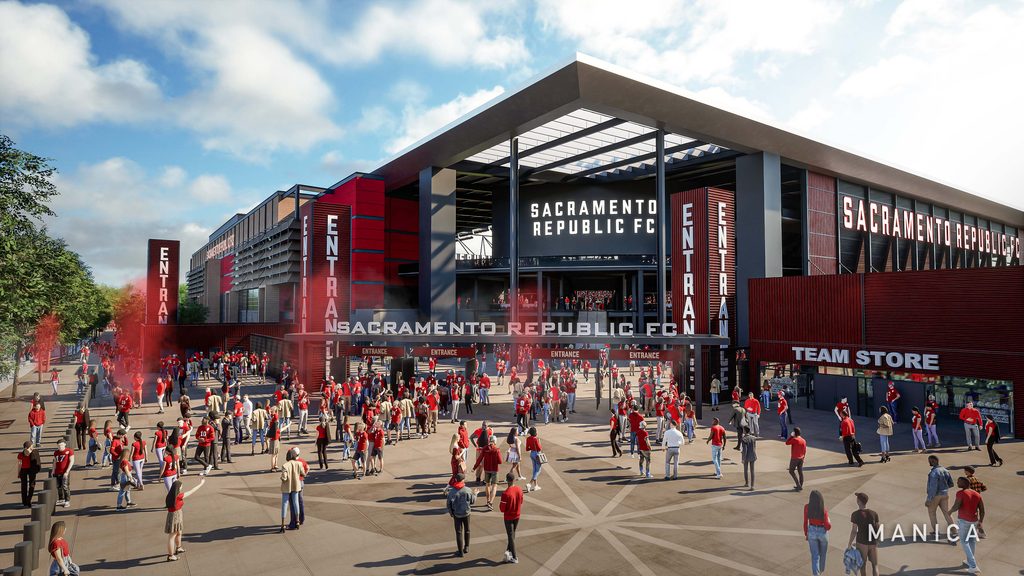
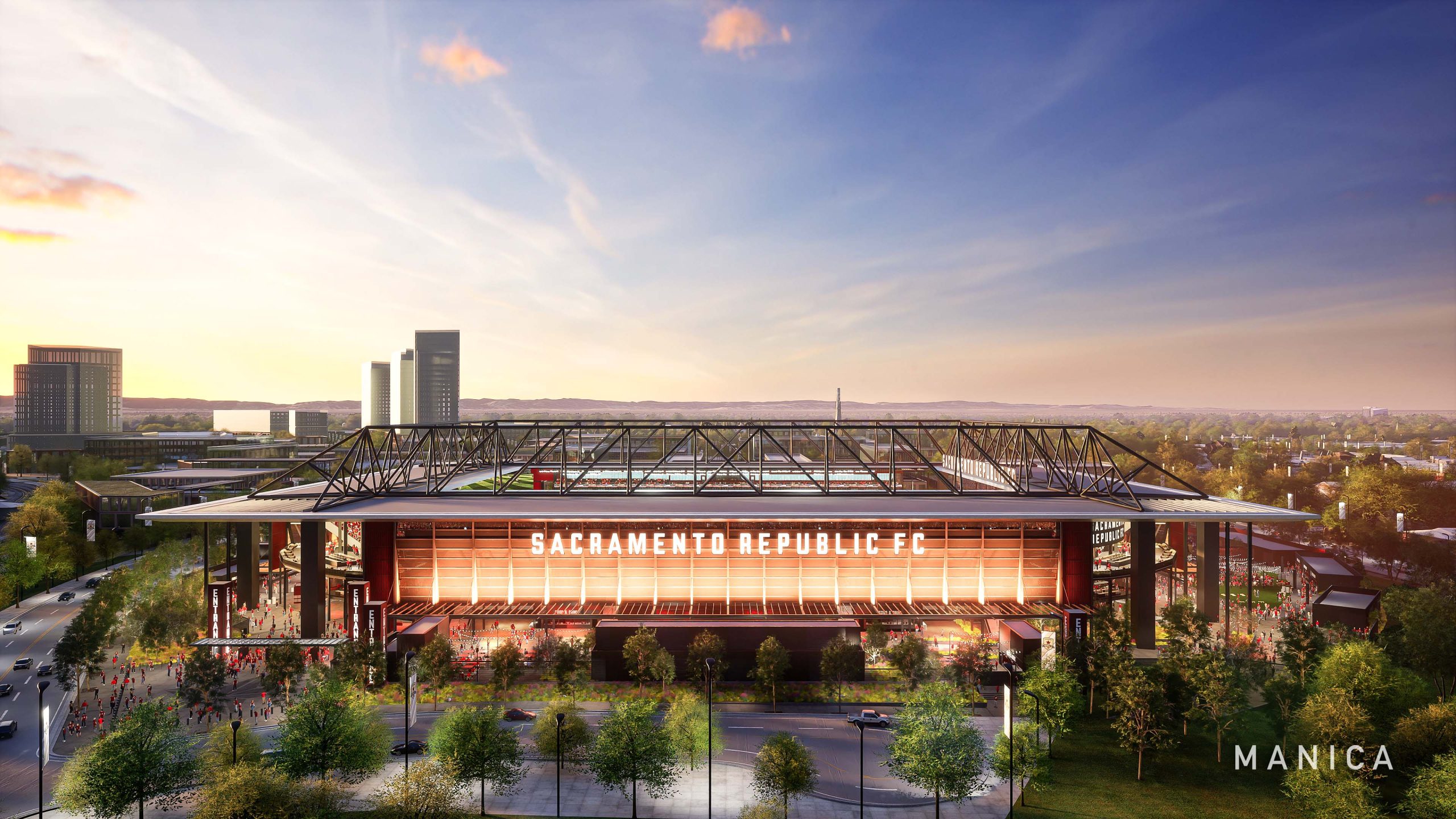
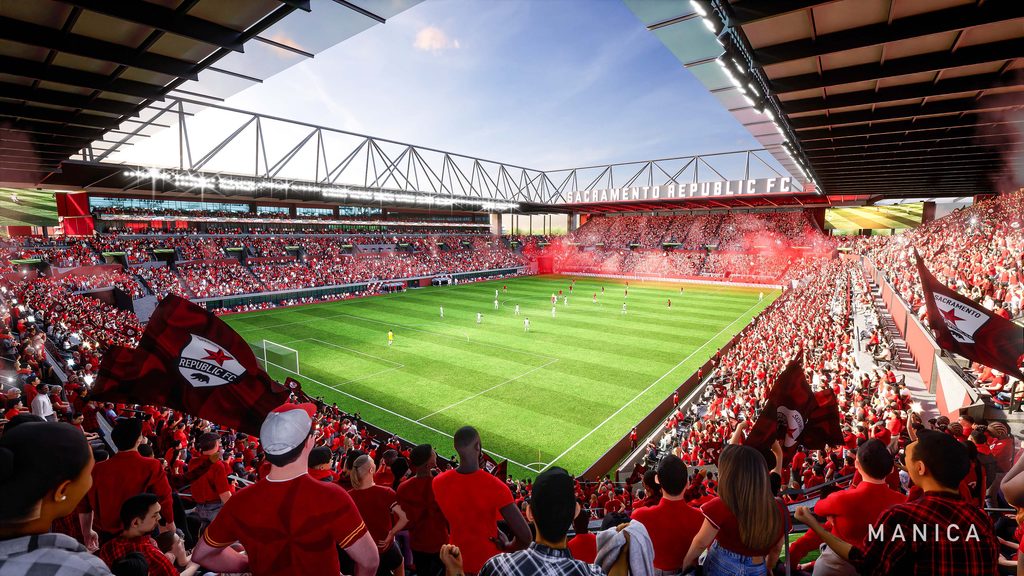
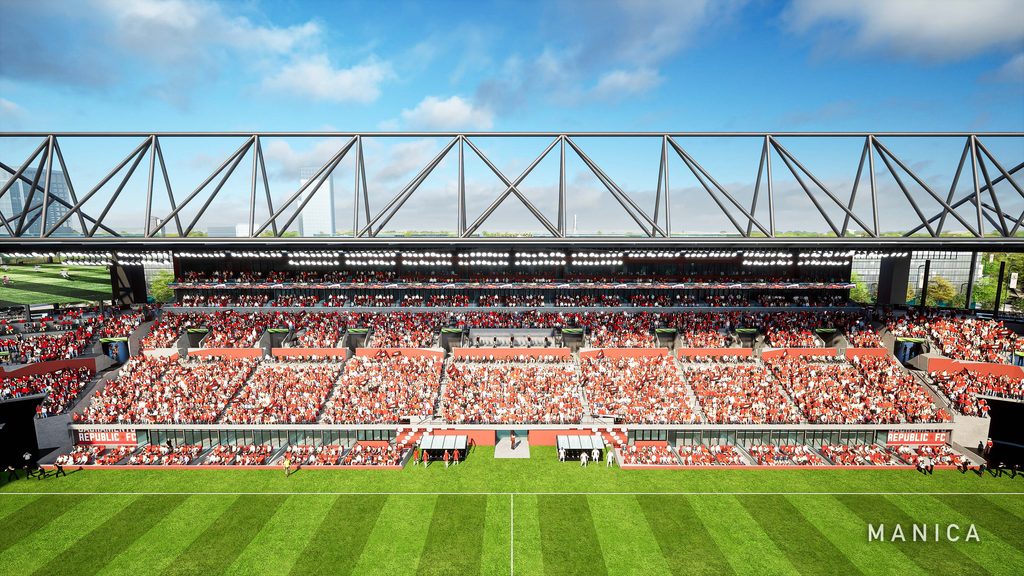
Set to spark a multi-billion-dollar urban development project at the long-barren Sacramento Railyards, Republic Stadium at The Railyards will become the new 20,000-plus-seat home of Sacramento Republic FC. The soccer-first venue will stand as the region’s largest professional sports venue.
Its canopy will provide coverage for every seat, supported by four massive trusses weighing a combined 3,800 tons — roughly three times the weight of the Tower Bridge. The structures evoke the railway bridge crossings that once stood near the site while adding another unmistakable, 12-story landmark to Sacramento’s skyline.
“Any time you can impact the skyline of a city – that’s pretty monumental,” Republic Vice President of Business Operations & Community Affairs Scott Moak said. “People create their own stories about what they see. That’s what we want. We’ll help guide them along with some of the things we’re strategically doing to make it feel uniquely Sacramento.”
In time, fans will forge their own memories and connections to the team’s new home. But long before the first match is played, its story is already woven into those thousands of tons of steel.
The vision for a stadium had existed in various forms for more than a decade, but each attempt ultimately fell short. The most significant came in 2019, when Republic FC targeted the same site as part of its Major League Soccer (MLS) expansion bid. That effort unraveled in 2021 after the team’s lead investor withdrew, leaving the bid in indefinite limbo.
Now, with the long-discussed stadium finally taking shape, speculation of a renewed MLS expansion push has resurfaced, and its scale has only amplified those conversations: the venue will surpass several soccer-specific stadiums currently used by MLS clubs.
Founded in 2012, Republic FC has competed in the United Soccer League (USL) since 2014. After splitting its inaugural season between Hughes Stadium, where it won its only championship, and then-Bonney Field at Cal Expo — now Heart Health Park — the club has called Cal Expo home for more than a decade. The USL serves as the second tier of the U.S. soccer pyramid, behind Major League Soccer (MLS).
“When this club was founded, it had ambitions to move downtown and grow into something bigger,” Republic FC Vice President of Communications John Jacobs said.
The bigger vision seemed just slightly out of reach. Then, the club’s fortune took a pivotal turn.
A Pitch-Perfect Partnership
In November 2024, Republic FC announced that Wilton Rancheria, Sacramento County’s only federally recognized tribe, would become the franchise’s primary owner, making it the first Native American Nation to hold majority ownership of a men’s professional sports team.
Kevin Nagle, whom Moak described as a “main character” in the story and a “bridge builder” for the franchise through years of uncertainty after his company acquired ownership in 2017, stepped aside from ownership during the transition and now serves as Managing Partner.
Less than a week after the tribe assumed its new role, the Sacramento City Council unanimously approved a framework that included the soccer stadium.
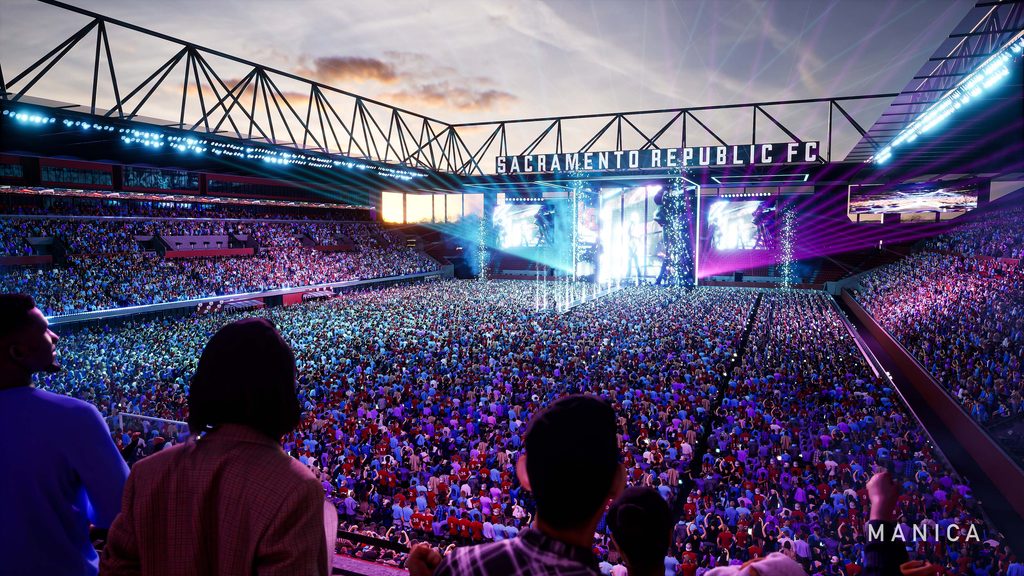
Now an up to $450 million project privately funded entirely by Wilton Rancheria, the venue is expected to be completed in 2028. Originally envisioned as a 12,000-seat stadium costing less than half as much, the commitment later expanded to 20,000 seats, with the capacity to host more than 27,000 people for various events.
“We believed Sacramento deserved to think bigger,” Wilton Rancheria Chairman Jesus Tarango said. “And we believed that if we were going to make this investment, we should do it in a way that matched the potential of the club, The Railyards, and the region.”
In 2020, Tarango was appointed Chairman, before being elected for a second and presumably final four-year term in 2024. The project, he said, not only provides the tribe a profound role in shaping Sacramento’s future, but an opportunity to reclaim the land on which it will stand.
“The Railyards are part of the landscape where our people have lived and maintained a connection for generations,” Tarango said. “For a long time, decisions about our lands and our future were made without us. Today, we have the economic strength and the sovereignty to be at the table and help make those decisions ourselves. That is what makes this opportunity so meaningful.”
“The Railyards are part of the landscape where our people have lived and maintained a connection for generations. For a long time, decisions about our lands and our future were made without us. Today, we have the economic strength and the sovereignty to be at the table and help make those decisions ourselves. That is what makes this opportunity so meaningful.”
The stadium officially broke ground in August 2025, turning more than a decade of plans and setbacks into something tangible.
“Every day, we’re further along in our stadium journey than we’ve ever been before. There’s a lot of crucial work happening now — infrastructure like sewers, utilities and roads, as well as the ground improvements that will soon become the stadium foundations,” Jacobs said. “The steel structures will begin to be assembled next year — and people will really be able to understand the scale of what’s just around the corner.”